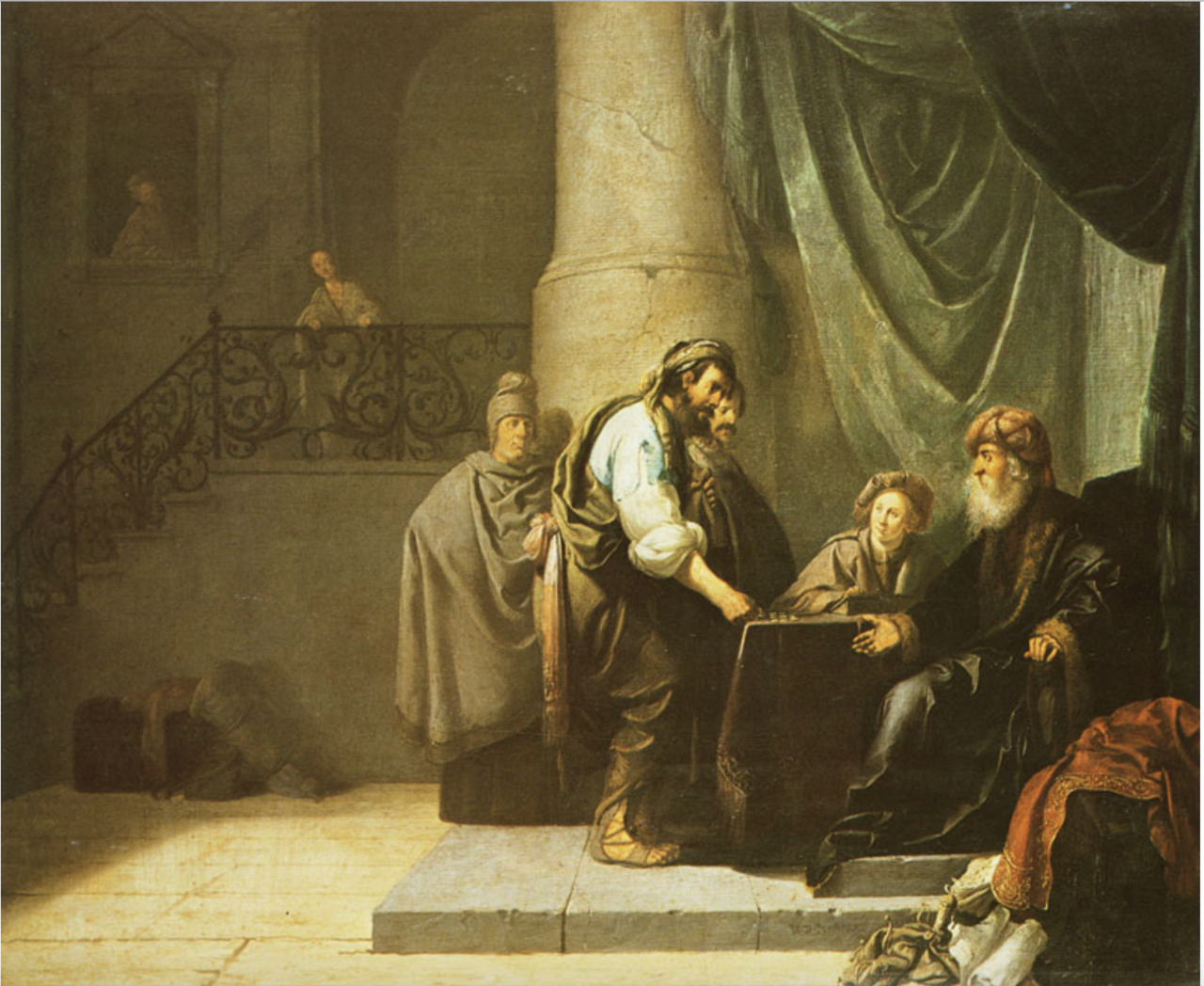
A Monday Meditation on Matthew 25:14-30
In Matthew 25 Jesus gives three distinct images, three memorable parables of the last days. It is a hearty counterbalance to our usual way of thinking about the end of the age. Some of us focus on “judgment day,” and tremble because of their sins. Others home in on apocalyptic images of battle and natural disasters, or of the “rapture,” when the faithful sort of get away from it all.
In Matthew 24, Jesus was clear that he would be coming back. And he was equally adamant that we can’t predict when that’s going to happen—much to the chagrin of Christian millennialists of every era.
- In the first story, Jesus’ return is a wedding banquet.
- In the third story, Jesus’ return is discernment between sheep and goats.
- But here in the second story, Jesus’ return is about analysis of investment portfolios.
The three images should work together, as I said in the preface to my children’s sermon on this passage, the way the four gospels function as we learn them. Each has its own distinct voice, and tells the story in four different orders with different emphases. But in our memories they blend together and we know it all as one story.
In point of fact one hardly ever hears any image of the judgment besides the last version in Matthew 25, the sheep and the goats. We really need to prompt ourselves to hear the other two parables as different, and equally important, images of what our Lord says the end will be like.
The Story
The parable has to be among the most easily recognized, even if it is not always thought of as a legit picture of the last judgment. It is the “parable of the talents.” A slightly different version appears in Luke’s gospel—but that one is never read as part of the lectionary.
The outline is simple:
- The rich boss guy is going on a long trip.
- He entrusts vast amounts of his wealth to three of his employees. The most competent gets the most. The least competent gets the least.
- While he’s gone two of the three invest the funds very profitably. They double the capital.
- The guy who got the least was scared, so he buried the Boss’s money. He returned the sum intact, but there was no profit.
- The master is pleased with those who invested and made a profit. He’s not the least amused with the guy who just kept it safe and returned it.
- The profitable servants get promotions. The other guy comes to the usual end: cast into the outer darkness with weeping and gnashing of teeth.
The Amounts
As always, it is the details that get interesting.
First there is the amount entrusted to each. I didn’t do any serious research, but one footnote of the Bible I have at hand says that a “talent” was about 20 years wages for a laborer.
- Minimum wage in Upstate New York is $16.00 per hour.
- At 8 hours per day, six days per week, 52 weeks per year, one year’s wages would be $39,936.
- Twenty yeas then, one talent, is $798,720. That’s the amount the master entrusted to his least trustworthy servant.
- Two talents? $1,597,440
- Five? $3,993,600.
I think if my boss handed me just shy of $1,000,000 and said to take care of it while he was away, I’d be tempted to bury it too
The Feelings
Then there is the emotion behind the three employees’ responses.
The first two? We don’t get a clear description. We do see that they hopped to it, and started trading with the master’s resources. They worked pretty diligently if they were able to double the Boss’s investment—even if it was, as the text says, “a long time”.
The last guy? The response of the one who was entrusted “just” $798,720 is very clear: he was afraid. His fear brought to mind the worst he knew or imagined about the master who trusted him. It is his fear and his projection that held him back.
I think the fact that he dug a hole in the ground and hid the money it is evocative of his feelings as well. I get the sense that he wished he could jump in that hole and pull it closed over himself.
The Projection
His speech is all projection:
I knew you to be a hard man,
reaping where you did not sow,
and gathering where you scattered no seed.
He kind of blames the master for trusting him with the money. There is no sense of being honored, of it being a great privilege to be trusted with such treasure. That kind of thinking was no motivation to do something as effortful and risky as trading to make a profit.
The Judgment
Compare the reaction of the master to the behavior of the servants.
The ones who took initiative and traded for a profit were called, “good” and “faithful.”
The one who buried the wealth was called “wicked” and “lazy”—even though he was given no instruction on what he should do with the treasure.
The Last Judgment in this passage? It’s all about your investment portfolio — your life investment, and God’s kingdom.
And Us?
It is the whimsy of history that the Greek word for an amount of money in this parable, “talent,” has made it to our times as meaning a resource or ability. It is no accident.
We get our own “talents” the same way as the servants in the parable. Our abilities come from God as a gift. We are born with certain aptitudes mentally physically and socially. They emerge in the course of life, catalyzed or nurtured or repressed by the contexts we happen to live in.
The parable teaches us that we are responsible for what we do with those talents. Will we hide them away—hide them even from ourselves? Or will we use them to make something more? At the very least will we build a life for ourselves, maybe provide for our family using our talents? In the bigger picture will we make something for God out of our raw materials, our gifts and talents?
My Sense of Calling
For me this is an extremely important text. I graduated from the University of Washington with a degree in business administration. As well as that training in business and marketing, I had a growing love for ministry. I had to choose a path.
I’d been doing tons of volunteer ministry in the college student groups of University Presbyterian Church in Seattle. But I had no “call from God”—if by that term you mean a voice from heaven.
I took a one-year, half-time volunteer internship in the university student ministry of First Presbyterian Church of Berkeley. To support myself I worked as a half-ime business manager for a small graduate school.
Over the weeks and months in Berkeley I found myself meditating on this parable. I eventually realized that just like in the parable, God had given me talents—and he gave me laughably little instruction about what to do with them.
The question where I would invest those talents.
And this parable gave me remarkable freedom. God did not have to tell me where and how to invest my talents. I had a choice.
- I could work in an administrative position. That could be my choice.
- Or I could pursue ministry. It would be my choice—even without that particular kind of “call from God.”
I did good work in my administrative job, but there wasn’t much joy in it. Actually, it was a bit soul killing.
By contrast, I found my ministry work both challenging and rewarding—and others seem to find it useful to them. The investment had been worthwhile.
I chose ministry. That was my call from God.
++++++++++++
I’m so glad you visited my site.
Please subscribe and you’ll get my Monday Meditations in my weekly newsletter.
Or better still: Support my work on Patreon! You’ll have my deep and lasting gratitude.


Leave a Reply