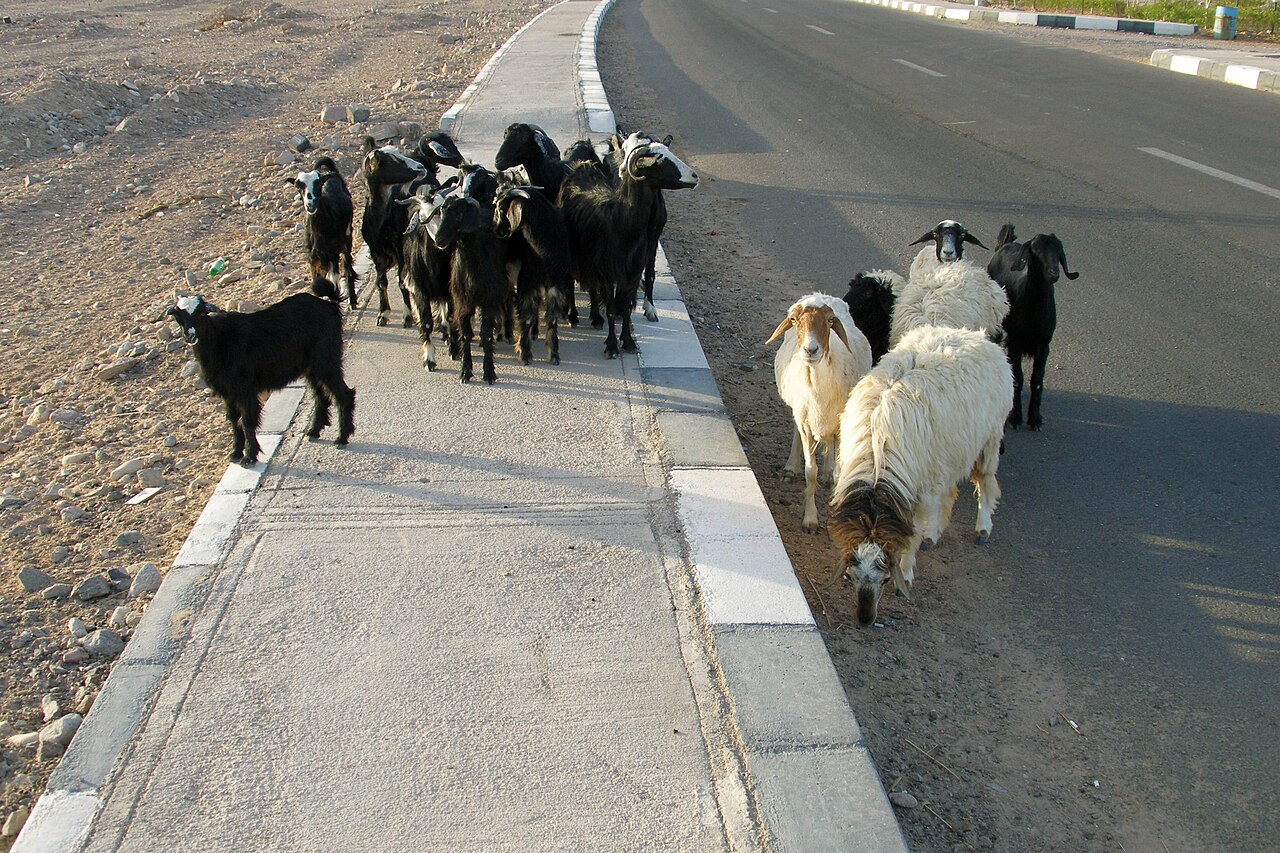
A Monday meditation on Matthew 25:31-46
This is the third of the parables that make up Matthew 25. In each of them Jesus gives us a portrait of his return—the end of the age, the day of the Lord, the last judgment, whatever you like to call it. He said in the previous chapter, clear as can be, that we simply do not, and absolutely cannot know when he is returning. What we are to keep at the forefront of our minds is that he is returning. So, perhaps to help us while away the idle hours (and millennia) of waiting, he gives us these three stories.
- The end will be a great party, a wedding banquet.
- The end will be an examination of our life’s investments.
- And this week, the end will be a discernment of sheep and goats.
Three Viewpoints on One Event
As I said in my children’s sermon on this text, it is spiritual healthy to keep in mind that all three of these are Jesus’ own portraits of his return. We are supposed to harmonize them in our mind, the way we do the four different Gospels.
Still, we tend to focus in on just this last one, the sheep and the goats. In my own denomination there has been a significant initiative to get congregations to sign on as “Matthew 25 churches.”
But do they mean churches that hold fast to the hope of a great big party coming? No.
Do they want churches to work on their investment portfolios, or those of the individual members? Not so much.
No it is strictly Matthew 25:31-46 they are thinking of. They want churches to commit to showing they are among the sheep by feeding the hungry, clothing the naked, visiting the sick and imprisoned, and welcoming the strangers.
An excellent plan. But if I’m gonna be a Matthew 25 sort of Christian, I think I should remember the whole chapter.
The Goat Problem
In this third story Jesus speaks most plainly about coming to judge. But he quickly slips into parable language, word pictures and imagined conversations, symbolic connections.
- Jesus shows up to judge.
- The people of the world are divided into two types of animals: sheep and goats.
I should note that there is nothing inherently unworthy about goats, No matter how poorly they fare in this parable. It was perfectly kosher to eat a goat instead of a lamb at the Passover feast. (Exodus 12:4-6)
There is that ritual of the “scapegoat” where one goat gets symbolically loaded up with everybody’s sins and sent packing. But that’s a whole different thing.
Perhaps it is intending to indicate that there is no inherent difference of worth or worthiness between the two categories at the judgment.
The nature of the judgment
The picture of the criterion by which one is discerned to be sheep or goat is excruciatingly clear. The sheep did the very kinds of things Jesus did: healing, feeding, welcoming, generally caring for the needs of others. The goats did not.
The surprise in the parable is the revelation of why this matters so much. Jesus, on the seat of judgment, surprises both sides by declaring that what they did to anybody, they actually did to him.
How is this so? I think Jesus reasons through two concepts that have been around since the Old Testament.
The Image of God
In the initial story of creation, we learn that human beings are created in the image of God. Something about the nature of human beings is recognizable as being like the one who created us.
When we love someone, the practical sort of of, like feeding them when they are hungry, we do honor to this reflection of God—something within us recognized and responded to this person’s humanity. This is so even if we don’t consciously think about this hungry person being made in the image of God.
Loving Neighbor as Self
The second Old Testament issue that is quite quietly relevant here is the command in Leviticus to love our neighbor as ourself. This is not worded as “love your neighbor as much as you love yourself.” Nor is it worded as “love your neighbor the same way as you love yourself.”
No. “Love your neighbor as yourself”.
It is a call to love your neighbor because you really are not separate. Your neighbor, somehow, quite invisibly, actually is you. If your neighbor is hungry, loving as self means you discovered that you are hungry. Of course you put food in the mouth of the one who is part of you.
The closest parallel in experience is when your children are hungry. Because of that biological link, you sort of feel their hunger. You just have to feed them.
This is by no means a popular way of reading that commandment. It is, however, what the commandment actually says.
So try reading this through the New Testament picture of “the body of Christ.” Jesus claims us and makes us his own body. When he reaches out to pat his own back, his hand falls on your shoulder. And when you go to provide for a need felt by your neighbor, loving is feeding the body that you are a part of.
Thus, Jesus says, when we do something for someone else, we do it to him.
A Protestant dilemma
The Protestant, with core theology deeply rooted in the 16th century Reformation, whether in Luther or Calvin et al,, is in a bit of a pickle when faced with this parable. Luther, Calvin, and all the rest we’re deeply convinced by the apostle Paul that salvation, justification before God’s judgment seat, is strictly a matter of grace freely given. We receive it by nothing but a trusting faith. No works ever count. No good deed ever has a causal role in justification.
So if Paul and the Reformers are right, where does Jesus get off telling us that at the judgment he’s going to take stock of the good we did, and decree we are sheep or goats based on how we treated the poor, hungry, naked, immigrant, sick, or prisoner? What’s a right-minded left-leaning justice-seeking Protestant Christian to do?
First off we’re best off not pitting Paul against jesus.
But second, both Paul and Jesus have vital and important things to teach us.
We’ll be better off if we take Paul seriously that nobody earns their place in heaven by good works. We can take solid hope from the words of the creed that it is Jesus who comes again to judge the living and the dead—Jesus who has, in fact, justified us, shown us God’s unstoppable love, made us safe in his care for life and for death.
And then, secure in the hope that in life and in death we belong to Jesus we take courage to look at what Jesus is saying here.
Sheep and goats
Take note that what Jesus says he’s doing is not weighing merits but discerning species. A sheep really is different from a goat.
Sheep to the right please.
Goats to the left, right this way.
The conviction of the reformers is that if we do have faith, then we are fundamentally changed. A relationship of deep genuine trust in the goodness and truthfulness of God will naturally result in doing good in the world.
Luther said faith means we no longer see God as a fearsome judge. By faith we know God as our loving adoptive father.
The Reformed would say that real faith fills us with gratitude. We’re so gobsmacked by what God has done for us in Christ that it makes us want to live a life that pleases God. They were confident that for a person of faith the spirit is at work deep within, changing you so you will inevitably do good to others.
So that is, I think, what we see in the parable. Jesus’ “judgment” is an examination of what species we have actually become. He knows what his sheep do: they care for people they meet.
They don’t individually have the capacity to solve global hunger or cure cancer, or stop the industrial prison industry. But they will love the hungry person they meet, the sick person they know about, the member of their community taken into custody by ICE.
When they do that they are reaching out as the body of Christ to the body of Christ, loving neighbor as self, seeing and honoring the image of God in the one they meet.
It isn’t reward for meritorious deeds. It is being on the path to life, a path that lives the truth revealed by the gospel.
Keep loving, little sheep. Love the one before you. Jesus recognizes his own and guides them home to life.
++++++++++++
If you find these meditations and children’s sermons helpful, please support my work on Patreon!


Leave a Reply